

Merchandising AI
Reduced SKU cleanup and image editing time by 6x for major retailers including Nordstrom, SHEIN, and Target.

Please note: This case study is currently in progress. I’m still adding final details, but wanted to share the process so far.
AI Product Transformation
Lorem ipsum dolor sit amet, consectetur adipiscing elit. Suspendisse varius enim in eros elementum tristique. Duis cursus, mi quis viverra ornare, eros dolor interdum nulla, ut commodo diam libero vitae erat.


Medium length hero heading goes here
Lorem ipsum dolor sit amet, consectetur adipiscing elit. Suspendisse varius enim in eros elementum tristique. Duis cursus, mi quis viverra ornare, eros dolor interdum nulla, ut commodo diam libero vitae erat.
AI Product Transformation
Lorem ipsum dolor sit amet, consectetur adipiscing elit. Suspendisse varius enim in eros elementum tristique. Duis cursus, mi quis viverra ornare, eros dolor interdum nulla, ut commodo diam libero vitae erat.
Overview
As Canal expanded to support large retailers like Nordstrom, SHEIN, and Target, it became critical to transform supplier product data into retail-ready listings — quickly and at scale. Each retailer had unique attribute and imagery requirements, making this a high-stakes, high-complexity challenge.
My Role
I led end-to-end product design—from discovery through delivery—for our AI-powered product data tool. This included research, workflow mapping, wireframes, prototyping, and close collaboration with Customer Success, PMs, and Engineering. I also leveraged DevinAI to ship fixes and features directly from Slack, accelerating iteration and minimizing engineering effort. While the tool is still evolving, the initial launch has already significantly reduced manual work and turnaround time.
Impact
- 6x faster SKU cleanup and image editing
- Sellers go live in weeks, not months
- Fewer errors and stronger retailer trust
- Helped position Canal as the most scalable solution in the market
As Canal onboarded major retailers like Nordstrom and SHEIN, supplier data and imagery often failed to meet each retailer’s unique requirements — leading to hours of manual cleanup, delayed launches, and inconsistent product experiences that hurt scalability and trust.
Inconsistent Product Data
Supplier attributes often didn’t align with each retailer’s requirements, causing data gaps and mismatches.
Imagery Misalignment
Retailers had strict image formatting rules that supplier photos rarely met — requiring manual editing and reordering.
Manual Review Bottlenecks
Even with AI, human review was required to catch brand-specific nuances — making the process slow and error-prone at scale.
AI helped automate a large portion of the transformation process, but human review was still required to ensure 100% accuracy.
We had an opportunity to drastically reduce manual effort by designing a tool that combined AI-driven enrichment with human-in-the-loop review — all in a single, scalable workflow.
Streamline editing and approvals in one place
Increase accuracy through smarter validation
Make AI more trustworthy by supporting human judgment
Deliver a faster, more reliable onboarding experience for large retailers
This wasn’t just about automation — it was about giving teams the right interface to collaborate with AI and ship high-quality product information, faster.
Learning Through Observation and Collaboration
Uncovering the Friction
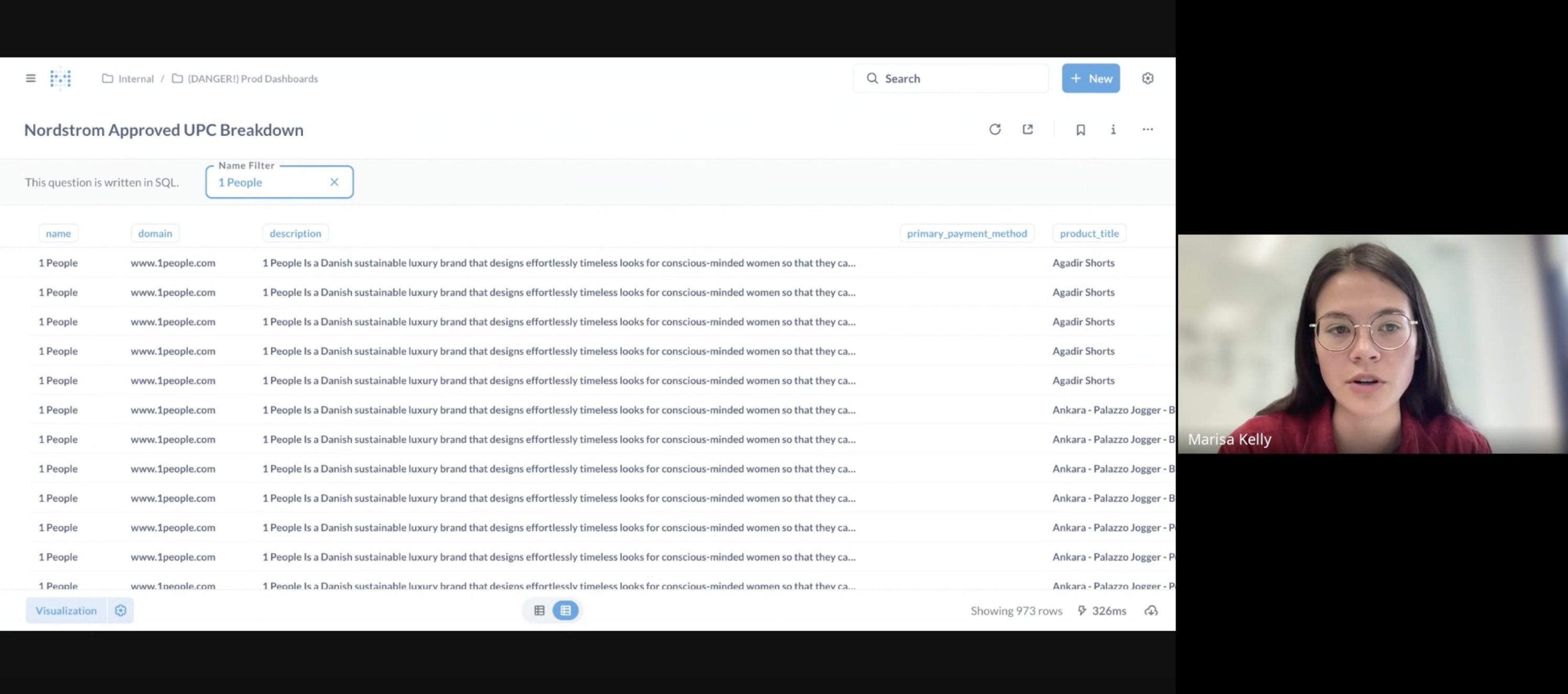
I shadowed the Customer Success team to understand how they manually reviewed and cleaned up product listings. The process was fragmented — toggling between spreadsheets, Slack, and Django admin to fix data issues, reorder imagery, and match each retailer’s specific requirements. These observations gave us firsthand insight into the friction, delays, and human effort required.
Collaborating with Retail Partners
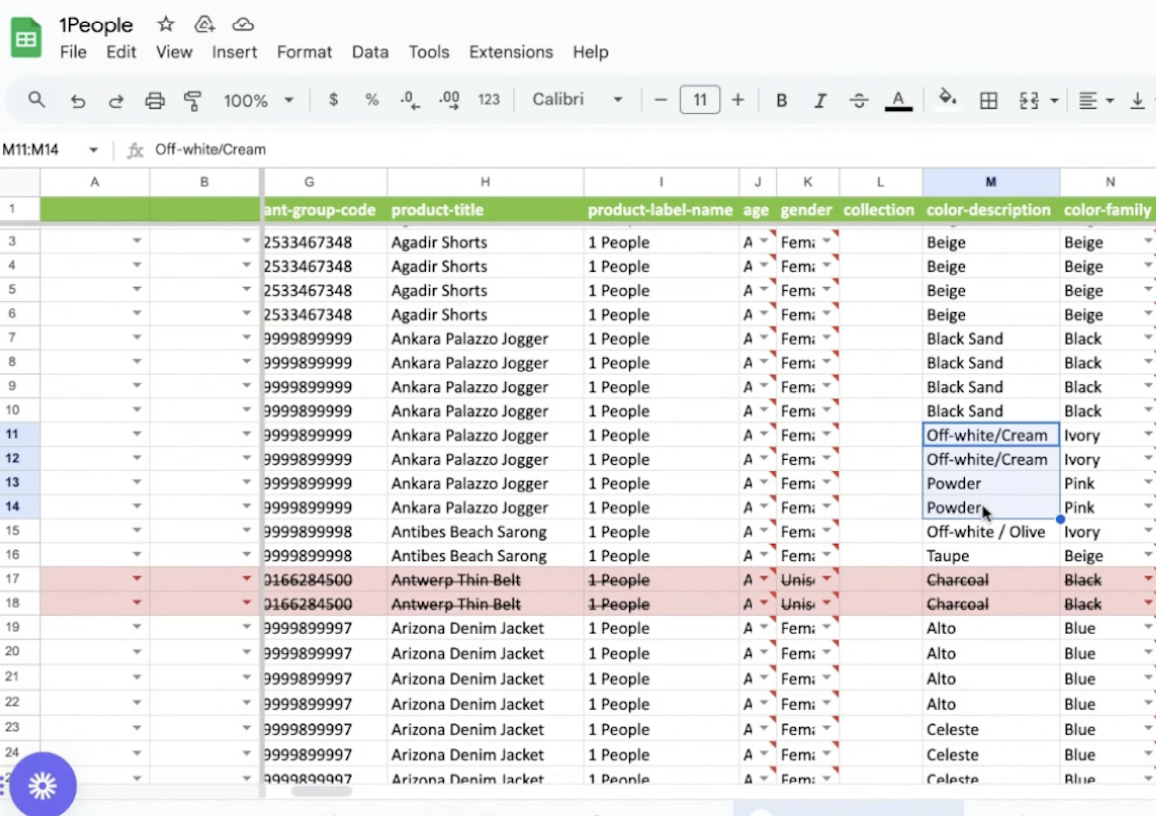
By working closely with retail partners like Nordstrom, we gained a deeper understanding of what “accurate” meant in context. For example, color naming conventions varied widely between brands, and visual expectations were often stricter than what suppliers provided. Their feedback helped us identify areas where AI alone wasn’t enough — and where human oversight was essential.
Pain points & patterns
Through working sessions and audits of real product data, we identified consistent friction points:
• Missing or misaligned product attributes
• Duplicate or invalid SKUs
• Inconsistent image formatting and order
• Brand-specific terms that caused confusion across retailers
These repeat issues became the foundation for designing smarter validation logic and a more focused review flow.
Designing Around Familiar Workflows
Team members consistently expressed comfort working in spreadsheets. They used tables to quickly scan for errors, sort large datasets, and perform batch edits. This behavior helped us define key experience requirements — like visibility, editability, and control — that would later influence our UI decisions.
With clear patterns and pain points uncovered, we moved into design — translating real workflows into a tool that balanced AI automation with human judgment and speed.
More project details coming soon...
Reach out to me for more details!
wireframing/planning section
Pain Points & Patterns
Through working sessions and audits of real product data, we identified consistent friction points:Missing or misaligned product attributesDuplicate or invalid SKUsInconsistent image formatting and orderBrand-specific terms (like “Seashell”) that caused confusion across retailersThese repeat issues became the foundation for designing smarter validation logic and a more focused review flow.
Designing Around Familiar Workflows
Team members consistently expressed comfort working in spreadsheets. They used tables to quickly scan for errors, sort large datasets, and perform batch edits. This behavior helped us define key experience requirements — like visibility, editability, and control — that would later influence our UI decisions.
Constantly looping in users for feedback
Here are just a few of the decisions we refined through close collaboration with users.
“Round 1, Round 2” — or something clearer?
I shadowed the Customer Success team to understand how they manually reviewed and cleaned up product listings. The process was fragmented — toggling between spreadsheets, Slack, and Django admin to fix data issues, reorder imagery, and match each retailer’s specific requirements. These observations gave us firsthand insight into the friction, delays, and human effort required.
Download or upload... or neither?
Some early concepts relied on CSV downloads and re-uploads to edit product data. But through conversations with the team, it became clear this was too slow and disruptive. I pushed for a built-in, spreadsheet-like editing tool — even though it wasn’t supported in our design system — and partnered with engineering to make it real using a third-party library (ReactGrid).
Bulk assigning images
Users shared that manually assigning images to SKUs was one of the most repetitive, frustrating parts of the process. I explored common patterns and designed a bulk assignment option with flexible controls — allowing users to map images quickly without losing precision.
Automating what doesn’t need a button
In one user observation session, I noticed the team had to manually refresh images in Django before approving a product. PMs had suggested adding a “Refresh” button to the UI — but I realized it shouldn’t be a button at all. I proposed that images auto-refresh upon saving edits. After walking through the logic with engineering, they quickly agreed: “Yeah, I was actually just thinking about this and totally agree.” This eliminated friction and saved the team time with zero extra clicks.
Built for accuracy & speed
See brand & product-level status’ at a glance
Bulk edit imagery and assign it to SKUs at ease
Fix product data and catch discrepancies before it’s too late
Built for rounds of review to reduce errors
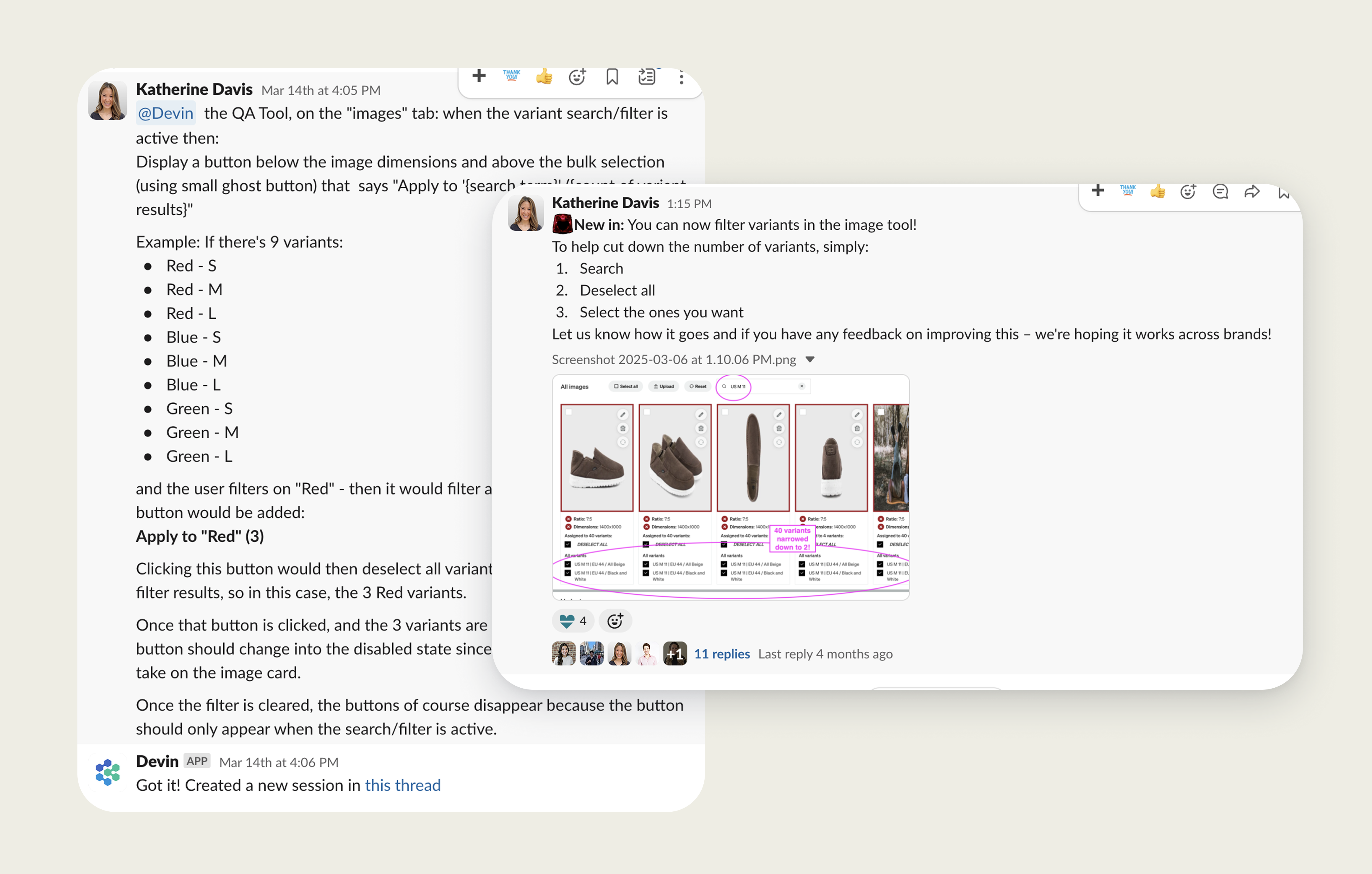
Designing and building faster with AI
In one user observation session, I noticed the team had to manually refresh images in Django before approving a product. PMs had suggested adding a “Refresh” button to the UI — but I realized it shouldn’t be a button at all. I proposed that images auto-refresh upon saving edits. After walking through the logic with engineering, they quickly agreed:“Yeah, I was actually just thinking about this and totally agree.” — Engineer This eliminated friction and saved the team time with zero extra clicks.
Speed, accuracy, and retailer trust at scale
Over 1,000x faster
From hours to minutes
Improved data
Prior to this tool, we were only reaching 70% accuracy in data, which our retailer partners did not accept, they needed 100% which this tool helped deliver
Faster onboarding
What used to take months now took minimal time. This allows Retailers to start selling more, faster
“Partnering with Canal has been an absolute pleasure. Their team is reliable, proactive, and deeply collaborative...”
— Katie Petroskey
Senior Manager, Brand Acquisition @ Nordstrom
What made this work
We worked in lockstep with users and engineering throughout the process — validating ideas, prioritizing the right problems, and building a tool that truly matched how the team worked. We didn’t just automate — we designed smarter workflows that combined AI, human expertise, and UX in a way that scaled beautifully. In addition, using AI to assist in the development process increased efficiency while directly shaping the user experience. It allowed us to refine and implement quickly — making the product more responsive, flexible, and ultimately more impactful. Overall, this cross-functional effort allowed us to quickly build a tool that saved time, reduced friction, and ultimately set us apart from competitors.